- Scribbling is neurological: Mark-making is not random mess; it wires brain-to-hand neural circuits required for future handwriting.
- Movement matures downward: Motor control migrates gradually from whole-arm shoulder swings down to wrist rotation and isolated finger grips.
- Highways beat dotted lines: Guiding toddlers along broad boundary tracks builds visual-motor braking years before narrow tracing drills.
- Praise the process: Celebrating intentional marks protects childhood motor confidence and fuels independent creativity.
When parents watch an eighteen-month-old toddler grip a chunky crayon in a tight fist and slash wild strokes across paper, the immediate reaction is often laughter or cleaning anxiety. To the untrained eye, it looks like pure chaotic mess.
In pediatric occupational therapy and early childhood development, however, those chaotic marks represent a profound developmental breakthrough. Scribbling is the literal birthplace of literacy and manual dexterity.
Before a child can ever write the letter “A” or trace their own name, their motor cortex must conquer the five developmental stages of scribbling. Understanding these stages allows parents and educators to support children with the right tools at the exact right moment.
What Are the 5 Stages of Scribbling in Child Development?
The five stages of scribbling are random kinesthetic marks, controlled rhythmic loops, visual boundaries and enclosed shapes, sensory-emotional expression, and thematic synthesis for early letter readiness. Each stage mirrors the natural neurological migration of motor control from large shoulder joints down to finger tendons.
Children do not skip stages, nor can they be rushed with rigid workbooks. Here is how each stage unfolds and how you can support your child’s natural progression.
Stage 1: Random Kinesthetic Marks (15 to 20 Months)
During this initial stage, mark-making is purely physical and sensory. Toddlers hold crayons using a full cylindrical palmar grasp, moving their entire arm from the shoulder and upper back.
The child is not trying to represent an object or picture. Instead, they are delighted by cause and effect: the realization that their physical movement creates a visible trail on the paper.
At this stage, provide large oversized sheets and chunky beeswax blocks. Our printable early developmental scribbling mats provide high-contrast story targets like sheep wool and storm clouds that channel these wild shoulder swings joyfully.
Stage 2: Controlled Rhythmic Loops and Swirls (20 to 30 Months)
Around twenty months, motor control migrates downward from the shoulder to the elbow and wrist. Children begin repeating identical motor patterns: circular swirls, horizontal back-and-forth zigzags, and rhythmic arches.
This is the stage where children discover muscle braking. They can stop their hand before the crayon flies off the edge of the paper, demonstrating developing hand-eye coordination.
Rhythm plays a massive role during this phase. Chanting continuous prompts like “Round and round the snail shell!” reinforces wrist flexibility and spatial endurance.
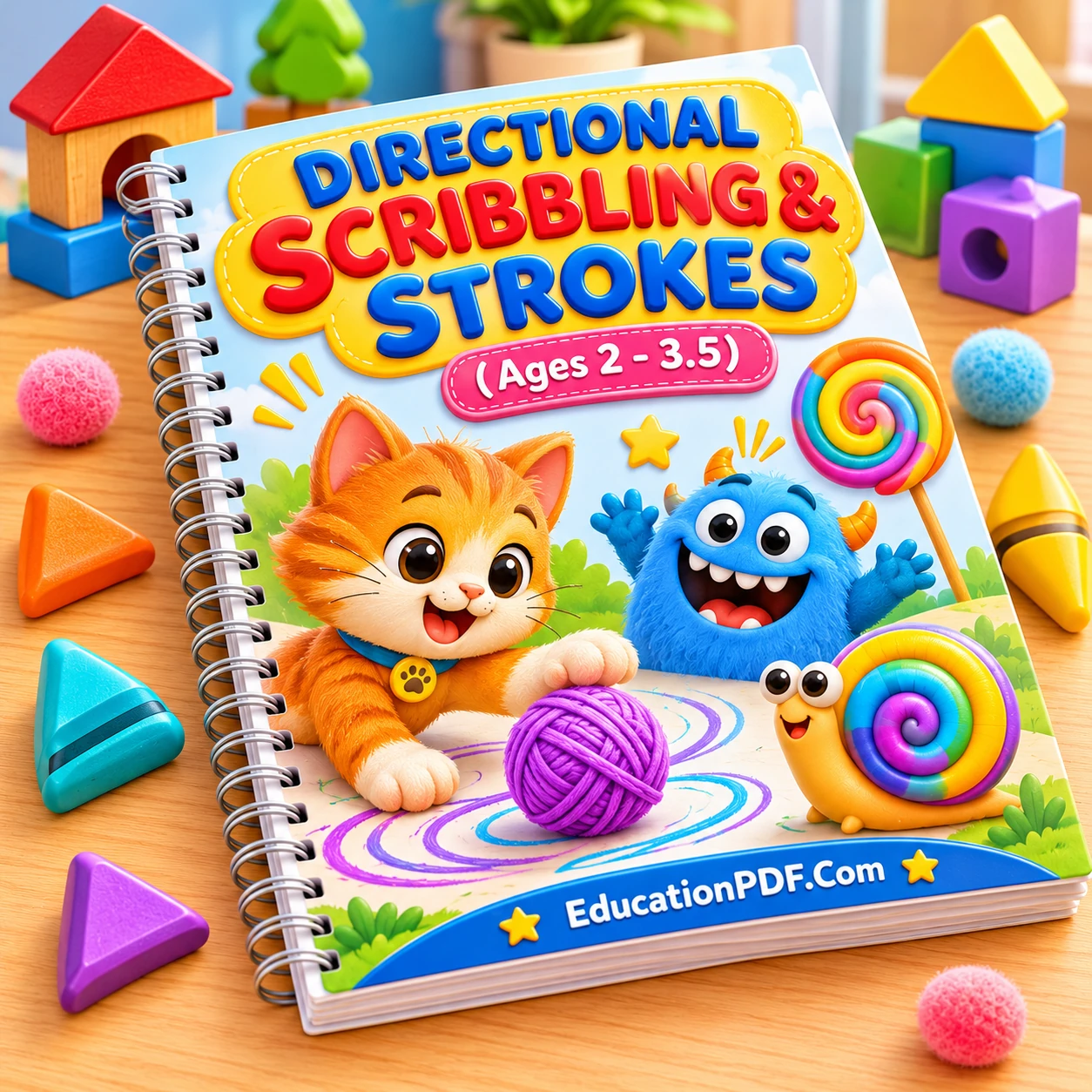
Directional Movement & Continuous Scribble Mats
10 fluid movement activity mats covering circular yarn, bouncy water ripples, and motor braking tracks. Includes printable PDF and full-page 3D cover art!
Stage 3: Visual Boundaries and Enclosed Spaces (2.5 to 3.5 Years)
Between two-and-a-half and three-and-a-half years, children achieve a monumental visual leap: closing a loop to form a distinct shape. They transition from endless lines to drawing approximate circles, crosses, and bounded zones.
Children at this stage also begin naming their scribbles after they draw them. A tangled circle with two lines extending from the bottom becomes: “Look, Mommy! That is a doggie!”
To strengthen this milestone, introduce wide boundary highways rather than thin dotted lines. Guiding a crayon along our pre-tracing boundary highway mats trains fingers to honor visual perimeters without creating performance stress.
💡 OT Insight: Why “Named Scribbling” Is a Cognitive Milestone
When a child assigns a name to their marks, symbolic thinking has arrived. They now understand that visual lines represent physical objects in the real world—the exact conceptual leap needed to decode letters and numbers.
Stage 4: Sensory, Tactile and Emotional Expression (3 to 4.5 Years)
By age three, children shift from involuntary grasp reflexes to conscious pencil pressure regulation. They experiment with energetic, heavy dark lines when frustrated or excited, and soft feather-light marks when calm.
This stage requires rich sensory feedback to prevent muscle fatigue and hand cramping. Peeling the wrappers off broken crayons for flat-side texture rubbings over leaves or coins teaches finger modulation intuitively.
You will also observe the emergence of the digital pronate grasp, where fingers point toward the crayon tip. Finger joints are now taking over from the wrist, paving the way for the functional tripod grip.
Stage 5: Thematic Synthesis and Early Letter Readiness (4 to 5 Years)
In the final stage before formal handwriting, children purposefully combine geometric shapes to create representational drawings. They draw stick figures with heads, bodies, and limbs, along with sunbursts, trees, and houses.
Children now possess the visual-motor integration needed for the nine pre-writing strokes: vertical, horizontal, circle, cross, diagonal lines, square, and triangle. Once these nine strokes are mastered, every letter in the alphabet can be formed with ease.
Rather than pushing rote alphabet drills, provide themed storytelling mats that unite cutting, coloring, and tracing into cohesive learning adventures.
Download the Pre-Writing & Fine Motor Academy Bundle
Get the complete 61-page educational system covering every milestone from first toddler scribbles to kindergarten letter confidence. Includes 56 printable activity sheets and 5 Occupational Therapy guides!
$14.99
(Only $10.49 with checkout discount!)
Frequently Asked Questions About Scribbling Stages
At what age should a child stop scribbling and start drawing recognizable shapes?
Most children begin transitioning from controlled scribbles to recognizable closed shapes between ages three and four. Expecting representational drawings before age three is developmentally inappropriate and places unnecessary pressure on early learners.
Should I correct my toddler when they hold a crayon in a fist?
No, you should never force an adult pencil grip on a young toddler. The fist-like palmar grasp is an essential developmental milestone that strengthens shoulder stability before finger muscles are physically ready to take over.
How does scribbling help with future handwriting?
Scribbling trains eye-hand coordination, strengthens the small muscles of the hand, and teaches spatial awareness on paper. Children who are allowed to scribble freely develop significantly higher handwriting endurance and pencil control in elementary school.